


Water quality testing
Our volunteers have been measuring water clarity, temperature and dissolved oxygen levels, as well as collecting water samples for Level 3 analysis, in partnership with the BC Ministry of Environment and the BC Lake Stewardship Society (BCLSS) since the late 1990’s.
Analysis of the collected data is ongoing. To date there have been two Monitoring Program reports published by the BCLSS and a Review of the data in 2017.
Some of the reports in the Timeline below are available upon request.
Timeline
1986 Executive Summary Report – Shuswap & Mara Lakes Water Quality Assessment
1997 to present Lake sampling for dissolved oxygen, temperature and Secchi disk readings.
Level 3 testing occurred when funds were available.
2005 - 2006 BCLSS Level 3 Lake Monitoring Report published
2009 Letter report of trophic status and health of the lake, Einarson presented at the Gardom Lake Planning
Committee at the CSRD
2010 Gardom Lake Monitoring Results to 2009, Powerpoint by Matscha
2010 - 2012 BCLSS Level 3 Lake Monitoring Report published
2012 CSRD published a Septic Report for Gardom Lake
2015 GLSS co-hosted the BCLSS conference at Gardom Lake
2015 - 2017 Water sampling and Level 3 monitoring of Upper Gardom / Mallory Creek
2017 Sokal Report - Review of Water Quality Data from Gardom Lake and
Upper Gardom / Mallory Creek
2023 & 2025 Nutrient (phosphorus and nitrogen) water sampling at Inflow and Outflow at
Wetland completed

Invasive plant control
Columbia Shuswap Invasive Species Society CSISS
For a number of years we've partnered with the Columbia Shuswap Invasive Species Society (CSISS) to monitor the spread of Yellow Flag Iris, an invasive plant that has been growing around the shoreline. CSISS does an annual evaluation of the Yellow Flag Iris eradication progress at Gardom Lake.
Yellow Flag Iris
The Yellow Flag Iris crowd out native shoreline plants like cattails and bulrushes and impact the habitat for wildlife. See photo. Our volunteers have put in many hours in boats and hip waders cutting down the foliage of these plants, and disposing it at the dump.
Woody Nightshade
Another invasive plant which is of concern is Woody Nightshade, which takes over wetland and upland areas, choking out other native plants. It has a purple flower in spring, and red berries that appear in summer. See photo.
Canadian Thistle
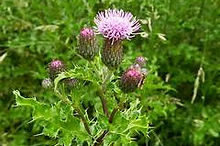
We hold an Annual Canada Day - Canadian Thistle Pull at the wetland each year. The thistles crowd out the indigenous plants. Our volunteers put in many hours each summer pulling the thistles.



Education
Education has been a big part of our mandate since our early days as Friends of Gardom Lake.
We have produced newsletters with information about the lake and its habitat, history, and things that we as residents can do to help protect the lake.
For visitors to the lake we produced the first-ever brochure about Gardom Lake and its habitat, and installed educational signage at various lake access points.
We have been gifted with several microscopes and once we can gather together again we have plans to use them to help educate young people about the importance of wetland habitats.
We are very pleased to be able to accompany and provide information to students to enhance their outdoor educational field trips. Our last excursion was with Vernon Community School in School District #22. Academy of Inquiry and Adventure

Wildlife conservation
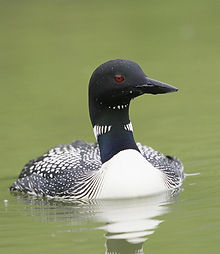
Gardom Lake is home to many species of birds, amphibians and mammals including loons, eagles, coots, red necked grebes, mallard ducks, wood ducks, kingfishers, ospreys, western painted turtles, rubber boas, blue tailed skinks, northern alligator lizards, moose, deer, muskrat, etc.
Gardom Lake has a nesting pair of loons and the Gardom Lake Stewards works with volunteers to place buoys with signs around the loon nest to encourage boaters to give them space during their nesting season. Unfortunately, in 2020 a mature male loon was found dead on the shores of Gardom Lake. The body was collected and sent to Environment Canada. The necroscopy results showed that the loon’s stomach contained coiled fishing line and a fishing lure (lead weight, copper spinner). The remaining female loon appears to have found a new mate as two loons have been seen attempting to nest on the lake in the years since.
Gardom Lake is a popular fishing destination and to find out more about the lead sinker issue we refer you to the Canadian government Occasional Paper Numer 108 of the Canadian Wildlife Service titled Lead fishing sinker and jigs in Canada: Review of their use patterns and toxic impacts on wildlife
We would like to work towards hosting more educational workshops to educate people about how to enjoy wildlife without disturbing them.

Turtle nesting site construction
Gardom Lake is home to many Western Painted Turtles. These turtles can be seen basking on logs around the lake on sunny days are protected by government. Please do not disturb or interact with the turtles you see on the lake. This includes those turtles you see on the roadways unless they are in danger of being run over. Disturbing turtles may jeopardize their egg laying. There are informational signs about the turtles available at the Musgrave Road Hand Launch site and at the Gardom Lake Community Park information Kiosk.
Gardom Lake Stewardship Society also manages the "Turtle Crossing" signs which warn drivers of areas where turtles may be crossing the road to lay their eggs. Many thanks to AIM Roads and their Community Improvement Project which allowed additional signs to go up in 2021 that indicate our roads are in a turtle area.
In an effort to keep mature female turtles off of our roads as they search for nesting sites and protect the newly hatched turtles as they leave their nests in search of water, GLSS has been working with private lakeside landowners to create dedicated turtle nesting sites. In 2019 the Murray-Carson Turtle Nesting Site was completed on private land. As well, there are two turtle nesting sites at the Musgrave Road wetland that were created in 2018 and 2022.

Gardom Lake Management Plan
Gardom Lake Stewardship Society was instrumental in bringing together various government agencies and groups of lake users to create a Lake Management Plan, completed in 2015.
The Plan includes a number of goals:
1) Maintain or improve water quality for Gardom Lake
2) Establish baseline water quantity data for Gardom Lake
3) Educate Gardom Lake residents and visitors about water quality
4) Maintain or improve the riparian zone of Gardom Lake
5) Maintain or improve the upland areas of Gardom Lake
6) Improve septic system health around Gardom Lake
7) Establish baseline recreation data for Gardom Lake
8) Restore Mallory Creek
LINK to document
Participants of the LMP process will continue to meet at least once a year to review the progress of the LMP.
Our accomplishments as Friends of Gardom Lake (FoGL) Prior to July 2015
-
Hosted the BC Lake Stewardship Society (BCLSS) Annual conference
-
Brought stakeholders together toward the creation of the Gardom Lake Management Plan
-
Voiced our concerns about changes to boat launch access on the Lake
-
Helped to move ahead the "electric motors only" status of Gardom Lake
-
Active participants of the Lake Management Planning Committee
-
Coordinated annual control efforts for reducing Yellow Flag Iris around the lake
-
Participated as volunteers collecting water samples in conjunction with BC Lake Stewardship Society (BCLSS) and the Ministry of Environment (MoE)
Our accomplishments as Gardom Lake Stewardship Society (GLSS) Incorporated July 2015
-
Coordinate events with the Columbia Shuswap Invasive Species Society (CSISS)
-
Organized annual control efforts for reducing Yellow Flag Iris and Canadian Thistle
-
Participated as volunteers collecting water samples in conjunction with BC Lake Stewardship Society (BCLSS) and the Ministry of Environment (MoE) for the lake and on Upper Gardom Creek / Mallory Creek
- Working toward LMP goals including organized review of LMP
-
Facilitated a 4H TrashBash garbage scavenger hunt at Gardom Lake
-
Participated in the Adopt-A-Highway program - organized volunteer clean-ups
-
Completed wetland construction Phase1 and Phase 2
-
Wetland planting, maintenance, improvements and monitoring
-
Completed three turtle nesting sites